Pre-Flight Briefing
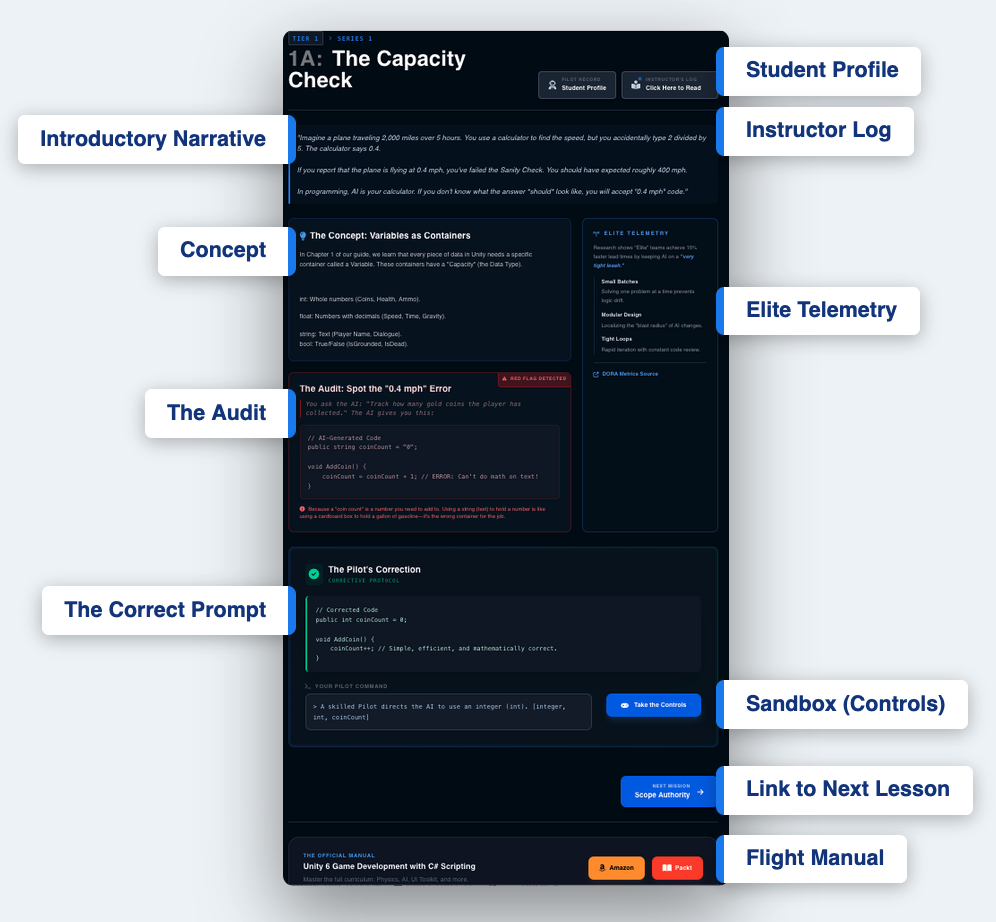
Welcome to the flight deck. Below is the comprehensive schematic of your mission interface. This site exists for one purpose: to train you to be the architect, not just the passenger, when building Unity projects with Artificial Intelligence.
Introductory Narrative
The "Sanity Check." A metaphor (like the plane speed calculation) that grounds the technical lesson in reality, reminding you that AI output must always be validated against common sense.
Concept
The "Concept Hangar." This is your pure theory block. It explains the C# or Unity architecture (e.g., Variables, Singletons, Object Pooling) before you touch any code.
The Audit
The "Red Flag" Zone. This displays fragile, unoptimized code often generated by generic AI prompts. Your job is to spot the error, just like spotting a mechanical failure on a dashboard.
The Correct Prompt
The "Corrective Protocol." This shows the specific technical keywords (e.g., "Use an Integer") a skilled pilot uses to guide the AI toward the correct solution.
Elite Telemetry
The "Mindset." A persistent reminder of the 3 core principles of an AI Pilot: Small Batches, Modular Design, and Tight Loops.
Student Profile
Your permanent service record. Tracks your completed missions, certification exams, and current rank (Cadet to Ace Pilot).
Instructor Log
Confidential Analysis. Click this to open a deeper, behind-the-scenes breakdown of why the specific code pattern matters for long-term project health.
Sandbox (Controls)
The Flight Simulator. Clicking "Take the Controls" launches the interactive Command Lab where you must type the correct prompt to pass the mission.
Link to Next Lesson
The Flight Path. Once a mission is cleared, this button propels you immediately to the next challenge in the series.
Flight Manual
External References. Direct links to official documentation (Unity Manual, Design Pattern books) for pilots who need to study the source material.
Becoming an AI Pilot
The difference between a novice and an Ace Pilot isn't how fast they code—it's how clearly they command. AI is a powerful engine, providing raw horsepower, but without architectural intelligence, it will drive your project off a cliff.
To succeed here, you must move beyond "asking" the AI for code. You must learn to Direct it. This requires knowing the answer before you ask the question. It requires a commitment to the Elite Telemetry mantra:
Small Batches
Never ask for a whole game. Solve one specific mechanic at a time to prevent logic drift.
Modular Design
Keep scripts separate. Localize the "blast radius" so an AI error doesn't break your whole project.
Tight Loops
Iterate rapidly. Audit every single line the AI generates before moving to the next task.
Your training begins now. Study the diagrams, respect the audit process, and always verify your instruments.